Saying goodbye to dandruff

Dandruff is much more common than one might think: almost one in two people will experience it at some point in their lives. Yet, it often remains a taboo subject, wrongly associated with poor hygiene. In reality, the causes are numerous and often independent of washing frequency: stress, an imbalance of the skin microbiome, overly aggressive products, or genetic predisposition. Understanding the origin of your dandruff is the first step to effectively and lastingly getting rid of it. Because the good news is that in the vast majority of cases, simple, gentle, and regular actions are enough to restore a healthy and balanced scalp. Here's everything you need to know to truly say goodbye to dandruff.

Understanding the causes of dandruff to better treat it

Before seeking a solution, it's essential to understand why dandruff appears. It results from accelerated cell renewal of the scalp: dead cells detach in visible clumps, forming these small white or yellowish flakes that fall onto the shoulders. This phenomenon can be triggered or worsened by several factors.

Stress, the scalp's number one enemy

Chronic or emotional stress disrupts the body's hormonal and immune balance, which directly affects the skin, including the scalp. During periods of intense stress, cell renewal accelerates, promoting the appearance or recurrence of dandruff. Managing stress through sleep, physical activity, and relaxation is an integral part of any effective anti-dandruff routine.

Overly aggressive treatments: the vicious circle

Paradoxically, trying to eliminate dandruff by frequent shampoos or harsh products often worsens the problem. An over-cleansed scalp reacts by producing more sebum to protect itself, creating an imbalance conducive to dandruff. The key is to choose gentle products, free of sulfates and harsh fragrances, and to not wash your hair more often than necessary.

Underlying skin conditions

In some cases, dandruff is a symptom of a specific dermatological condition: seborrheic dermatitis, scalp psoriasis, or an allergic reaction to a product. These more persistent forms, often accompanied by redness or intense itching, require medical consultation and appropriate treatment. A dermatologist can make an accurate diagnosis and recommend suitable solutions.


Everyday actions to soothe the scalp without damaging it

Once the causes are identified, dandruff treatment primarily relies on regular and gentle practices. No need for complex protocols: a few adjustments to your hair routine are often enough to see visible results within a few weeks.

Regular brushing: an underestimated act against dandruff

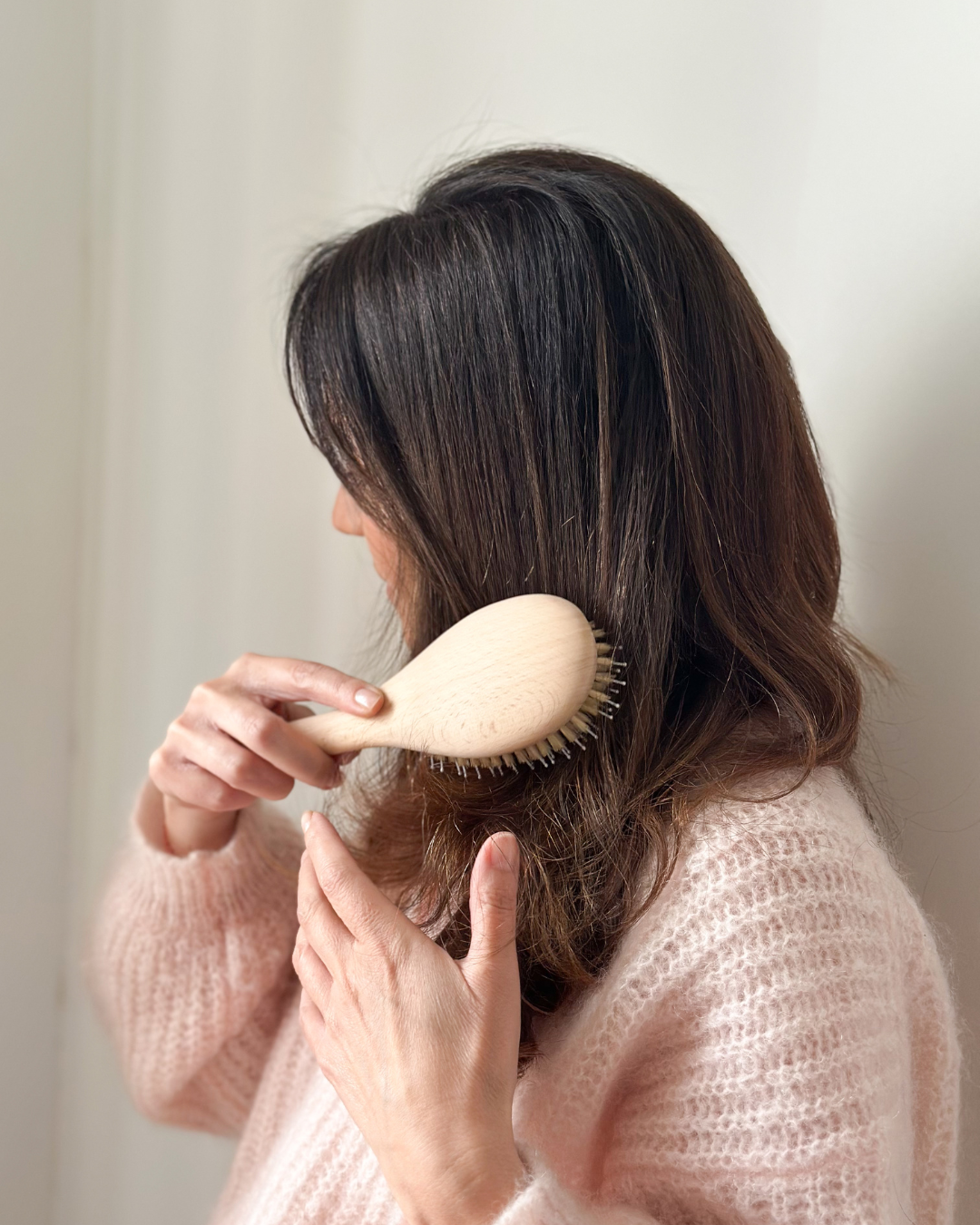
Brushing your hair daily is one of the most effective ways to combat dandruff. Brushing mechanically removes visible flakes, stimulates blood microcirculation in the scalpand promotes better oxygenation of hair follicles. It also helps distribute sebum evenly from the scalp to the ends, preventing its accumulation at the roots.

To be beneficial, brushing must be gentle and regular.A brush suited to your hair type,with well-spaced bristles mounted on an air cushion, allows you to massage the scalp without irritating it. Our hair diagnostic helps you identify the best brush for your profile in just a few seconds.

Gently massage the scalp

Scalp massage, performed with the fingers or during brushing, stimulates blood circulation and promotes the gentle elimination of dead cells. A few minutes a day are enough to achieve a soothing and stimulating effect. This simple action, practiced regularly, contributes to rebalancing the scalp in the long term.

Adjust the water temperature and the heat of styling tools

Water that is too hot during shampooing exacerbates dryness and itching of the scalp. It is recommended to rinse with lukewarm water, or even cool water at the end of washing, to tighten pores and limit irritation. Similarly, using a hairdryer too close to the head or at an excessive temperature dries out the scalp: maintaining a distance of at least 20 cm and favoring moderate heat are simple actions to adopt.

Natural solutions for a healthy scalp

In addition to daily habits, certain natural solutions have proven effective in reducing dandruff and providing lasting relief for the scalp. They can be easily integrated into a minimalist and respectful routine.

Vegetable oils: natural allies for the scalp

Some vegetable oils have soothing, moisturizing, and antifungal properties that are particularly effective against dandruff. Coconut oil is known for its antibacterial and antifungal properties, which help regulate the proliferation of the Malassezia fungus, often implicated in the appearance of dandruff. Jojoba oil, whose composition is similar to natural sebum, helps rebalance the skin microbiome without weighing down the hair.

Oil bath: how to use

Apply a few drops of vegetable oil directly to the dry scalp, gently massage in circular motions for a few minutes, then leave on for 30 minutes to overnight before shampooing. An oil bath performed once or twice a month is sufficient; beyond that, there is a risk of overstimulating the scalp and worsening sebum production.

Opt for gentle and suitable shampoos

A shampoo free of sulfates, silicones, and harsh fragrances is the foundation of an effective anti-dandruff routine. For persistent dandruff, shampoos containing piroctone olamine, zinc pyrithione, or ketoconazole are particularly recommended, as these active ingredients directly target the fungi responsible for dandruff. In all cases, alternating with a gentle shampoo helps prevent long-term weakening of the scalp.

Adopt a long-term anti-dandruff hair care routine

Dandruff is a common, often benign problem that should never be a source of shame. Stress, unsuitable care, scalp imbalance: the causes are identifiable and the solutions are accessible. The key is to adopt a gentle and regular approach: mild shampoos, occasional oil treatments, daily brushing adapted to your hair, rather than trying to strip or treat urgently. At Bachca, we believe that taking care of your scalp begins with the right technique, with the right tool. A brush adapted to your hair type, used gently every day, is one of the simplest and most effective ways to restore a balanced scalp and healthier hair.

FAQ's

Is dandruff contagious or a sign of poor hygiene?

No, dandruff is neither contagious nor linked to poor hygiene. It results from accelerated cell renewal of the scalp, often exacerbated by stress, hormonal imbalance, overly aggressive hair products, or genetic predisposition. Paradoxically, washing hair too often with harsh shampoos can worsen the phenomenon by disrupting the scalp's natural balance. The key is not to clean more, but to clean better, with gentle and appropriate products, and to adopt regular practices such as daily brushing to stimulate the scalp without irritating it.

How long does it take to get rid of dandruff with natural remedies?

Results vary depending on the severity of the dandruff and the consistency of the care. For mild to moderate dandruff, a visible improvement is generally observed after three to six weeks of an appropriate routine: gentle shampoo, occasional oil baths, and daily brushing with a suitable brush. For more severe or persistent dandruff, treatment may take longer and require specific products containing antifungal active ingredients. If no improvement is observed after six to eight weeks, it is recommended to consult a dermatologist to rule out an underlying skin condition such as seborrheic dermatitis or psoriasis.

What hairbrush should you choose when you have a sensitive scalp and dandruff?

For a sensitive or dandruff-prone scalp, it is essential to choose a brush with soft, widely spaced bristles mounted on an air cushion that absorbs pressure with each stroke. A brush that is too dense or has rigid bristles risks irritating the scalp and aggravating itching. The Bachca Detangling and Shine Brush, which combines soft nylon bristles and boar bristles, is particularly suitable: it gently stimulates the scalp, removes flakes without rubbing, and promotes microcirculation with each brushing.

I want beautiful hair

Faites votre diagnostic Bachca pour recevoir plein de conseils adaptés & connaître la brosse faite pour vos cheveux.

JE FAIS LE DIAGNOSTIC