


How to avoid hair breakage when detangling?
Hair breakage is one of the most common hair problems… and one of the most frustrating. Thinning ends, lengths that no longer grow, dull or uneven hair: very often, the cause is neither shampoo nor treatments, but a daily step too often neglected, detangling.
When done incorrectly, detangling weakens the hair fiber, creates invisible micro-breaks, and gradually damages the hair. Conversely, when performed with the right techniques and tools, it becomes a true care ritual, capable of preserving the length, softness, and vitality of the hair.
At Bachca, we believe that beautiful hair starts with the right accessories and a gentle approach. Here's a complete guide to understanding why hair breaks during detangling and, more importantly, how to prevent it permanently.
Why do hair break when detangling?
To prevent breakage, it's essential to understand how it works. Hair fibers are strong, but they aren't indestructible. When subjected to repeated stress, they eventually break.
The primary cause of breakage is excessive pulling. Pulling on a knot, forcing a brush through it, or detangling too quickly creates direct tension on the hair fiber. This tension is even more problematic in wet hair, as water makes hair more elastic but also more fragile.
The second cause is related to dryness. Dry hair lacks suppleness; its cuticles are more open and snag more easily. When detangling, it offers more resistance, which promotes breakage.
Finally, choosing the wrong tool plays a major role. A brush that is too stiff, poorly designed, or of poor quality will snag the fiber, increase friction, and multiply the points of breakage.
Detangling, a key step in hair health
It's often forgotten, but detangling is one of the times when hair undergoes the most mechanical stress. Unlike washing or styling, it acts directly on knots, where the hair fiber is already weakened.
Aggressive detangling doesn't necessarily break the hair in two immediately. Rather, it causes micro-fissures which, repeated day after day, eventually thin the lengths and weaken the ends. This is how we get the impression that the hair has stopped growing, when it's simply breaking off gradually.
Adopting a gentle detangling method is therefore essential to maintain healthy hair in the long term.

Adapt the detangling method to the condition of the hair
Hair reacts differently depending on whether it is dry, damp, or wet. Adapting your technique to its condition is essential to prevent breakage.
When hair is wet, the fiber is more vulnerable. Detangling must therefore be particularly gentle, ideally after applying a detangling treatment that provides slip and softens the hair fiber. The movement should be slow, gradual, and controlled.
On dry hair, the main risks are dryness and static electricity. If the hair is very tangled, it may be best to lightly dampen it or apply a leave-in conditioner before detangling.
In any case, forcing it is never the solution. If a knot resists, it's better to stop, go back and loosen the strand rather than pulling.
Always start with the tips: the fundamental rule
The first rule to avoid breakage is simple, but too often ignored. Untangling starting from the roots pushes the knots towards the tips, compacts them and considerably increases the tension exerted on the fiber.
Starting at the tips, gradually untangle the knots without creating resistance. Once the lengths are free, it becomes much easier to work your way up to the mid-lengths and then the roots, without pulling or breaking.
This progression respects the structure of the hair and greatly limits mechanical breakage.

The importance of a truly suitable tool
Choosing the right brush or comb is crucial to minimizing breakage. A good tool should move with the hair, not restrict its movement.
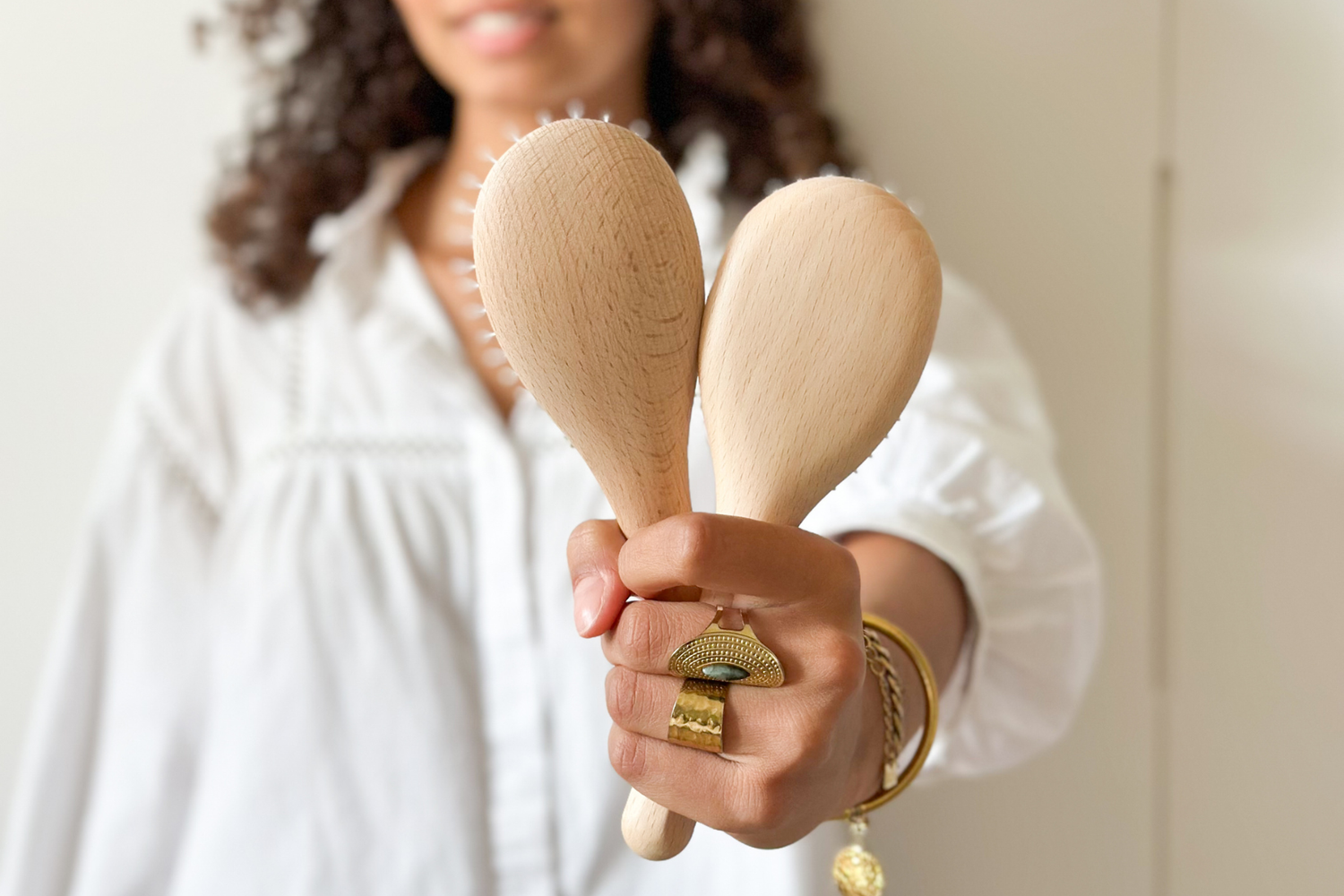
Our brushes were designed to address this very challenge. Their air cushion absorbs the pressure exerted during detangling, thus reducing tension on the scalp and hair. The bristles are flexible enough to glide through the hair without snagging, yet effective enough to remove knots.
The beechwood handle provides essential stability and ergonomics. A good grip allows you to control pressure, avoid sudden movements, and detangle with greater precision. This ease of use significantly reduces the risk of breakage due to overly rapid or poorly controlled movements.
The key role of care in preventing breakage
Well-hydrated hair is easier to detangle. Therefore, hair care products are not just a supplement, but a true ally against breakage.
Conditioner is essential for sealing the hair cuticles and softening the hair fiber after washing. A hair mask, used regularly, strengthens the hair structure and improves its resistance. Leave-in treatments, meanwhile, make daily detangling easier by adding slip and protecting the lengths.
When the fiber is nourished and supple, detangling naturally becomes easier and less aggressive.
Work in sections to reduce tension
Detangling all of your hair at once is one of the most common mistakes. This creates multiple areas of resistance and increases the tension on the hair.
By dividing the hair into sections, the process becomes more precise and gentler. Each strand is detangled individually, allowing for better control of pressure and preventing repetitive movements in the same area. This method is particularly beneficial for long, thick, or curly hair.
Curly hair and breakage: special attention is needed
Curly hair is naturally more fragile because its spiral structure creates areas of tension along the hair shaft. It is also drier, which increases the risk of breakage when detangling.
Detangling should ideally be done on damp hair, using a suitable product and a soft tool. The movement should respect the shape of the curl, without stretching it excessively. Bachca brushes, thanks to their flexibility and balanced design, allow you to detangle without breaking the curl or weakening the hair fiber.
Reducing daily breakage, beyond just detangling
Breakage doesn't only occur during detangling. Nighttime friction, unsuitable accessories, or overly tight hairstyles also weaken the hair fiber.
Using soft accessories, avoiding tight elastics, and protecting your hair at night helps limit knots and therefore reduces tension during subsequent detangling. The fewer knots, the less stress the hair has on it.
Why Bachca accessories make a difference
At Bachca, every accessory is designed to gently and effectively support your daily routine. The brushes and combs are designed to respect the hair fiber, minimize friction, and offer optimal user comfort.
This attention to detail, whether it's the flexibility of the bristles, the balance of the wooden handle, or the quality of the materials, significantly reduces breakage during untangling. These aren't spectacular promises, but concrete design choices that make a difference in use.
Hair breakage during detangling is not inevitable. It is often the result of rushing, insufficient preparation, or using unsuitable tools. By taking the time to detangle properly, respecting the hair's structure, and using gentle accessories, it is possible to preserve the health of your hair in the long term.
With gradual movements, appropriate care, and brushes designed to move with you, like our Bachca brushes, detangling becomes a true pampering experience. A simple yet essential step for stronger, more beautiful, and less brittle hair, day after day.